
I recently had the pleasure of interviewing Lionel Cole, a jazz musician and all-around Creative. Son of Freddy Cole and nephew of Nat King Cole, Lionel’s musical talent was encouraged from a young age. Now, it’s his mission to spread love through music and encourage people to find their voice.
You can listen to the episode here.
Despite my best attempts at editing, there are some sound quality issues. Here is a transcript of our conversation you can read instead or along with the episode.
Erika:
Welcome to Creative Life, the podcast about consciously creating your unique and purposeful life through creativity and play. I’m your host, Erika Lewis, artist and Creative Life Coach. And together we’ll explore how to use art, habit change, and powerful shifts in perspective to cultivate wellness as individuals and communities.
Today, I’m excited to introduce my very first guest. Lionel Cole. Lionel Cole is a gifted and prolific artist in a variety of fields, including as an actor, martial artist, host for the radio show Center Stage, copywriter, television producer, Fulbright lecturer, and more. Out of all the things he’s done, in Lionel’s words, music is his bestie and is a language of love that he uses to inspire people to find their voice. He started young with his first professional show at six years old. He’s the lead singer of his band, has repeatedly toured with Mariah Carey as a pianist, and competed on The Voice Australia. Throughout his illustrious career he’s won and been nominated for many Grammys and Emmys, and he’s a longtime family friend.
Hi, Lionel. Thank you for being here today. So tell us, what have you been up to recently?
Lionel: Well, during the Christmas season all the way up to about the beginning of February, we were on tour for our last record by Lionel and the Swingers Club, With Love, and Cancel Christmas. Uh, it’s really cool. They both got Grammy consideration last year. And we’re, uh, you know, we’re just itty bitty independent label guys who think they can, like a little choo choo train. So we’ve done all right, and um, we’ve got a new one coming out on May the 1st, and we start back where you saw us, at 54 Below, on the 14th of May.
So things are going really well, I’m really excited about the new record, and I have you, and another one next week, I had one last week, people are all, they’re all saying hello, which is really quite nice. And I have a radio show myself on American Airlines and, uh, got to interview Allison Russell just the last couple of days from she is incredible. And it’s just wonderful to see you do your thing because I mean, I love radio. I love podcasting. I love what you do. So thank you for making time for me to be your number one.
Erika: Yeah, it’s very exciting. You got a lot of big things going on. What’s the process like of being nominated for a Grammy?
Lionel: Well, someone who knows you and is a governor or a voting member has to bring you to the table. And then everybody gets their five votes or whatever they are that each person has. And then there’s an initial cutoff. Uh, and then there’s a secondary cutoff, which is what we made it to, the consideration, and then the next one is nomination. So we’re hoping that this year’s record “Small Town, Vol. 1” one gets the nomination. That would be a coup and a good fun. You know, it’d be the first Grammy I would have won on my own. I’ve won on my arrangements already, but it’d be really cool.
Erika: Yeah you’ve won and been nominated for a bunch of projects that you worked on. So, I want to go back to the beginning. What were you like as a child?
Lionel: Um, I think some would say maybe a little pretentious. I haven’t changed much since I don’t mean to be a smart aleck, but it comes out.
Life is wondrous and funny, for the most part. Even if, you know, you’re crying wondrous tears of sadness, it’s pretty much amazing. And when I was a kid, I thought the same thing. So it was lots of, you know, ducking punches and trying to explain why I was so weird. So I’d go back and explain that to my piano and my drum set. And, you know, that became my link to myself. And, uh, so yeah, music was like, even though I had animals, music was like my, my bestie, no matter what happened, I could go down and talk about it at the piano and get it out. So yeah, the connections are quite deep.
I did my first professional show at six, you know, so finding a way to let the artists live while you’re being a performer is a very interesting task. But so far, the artist is still here, so I’m pretty excited about it.
Erika: Yeah, I was curious about that, about how your creativity, the thing that you loved from a young age, how does that change once it’s tied to your career and all those responsibilities?
Lionel:
I do music because I think it’s the best way to touch as many people as possible. Like, it’s really, it’s the space from which the language of love can be most easily understood. And so I’m open to wherever creativity blows me, working on a symphony and an opera, a soul record, a weird chill hop record, and then, you know, this Americana, whatever record that this is. And I just find if I let myself dream big within my own sphere of creation, then the world brings all these interesting things to, to a point.
I, I didn’t nominate myself for a Grammy. The drummer in the band was like, Hey man, you’re an idiot. I’m going to make my friend nominate you. So he nominated me. So I had to put the record out, you know creativity brings with it the movement of the universe as well. You know, Gerda said, you know, once you commit, all sorts of things in the universe come to aid and bear, and I think creativity is the same thing that if you, if you commit to a creative life, life will create ways to let you continue to do so.
Erika: So you’re co creating with the universe.
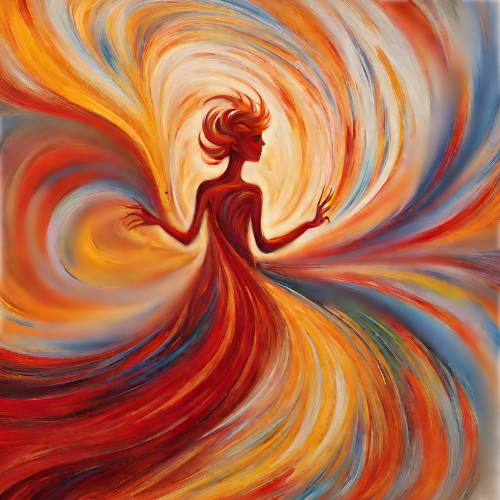
Lionel: Absolutely. Absolutely. Laughing on the ride, thinking I’m making choices, you know, because creativity doesn’t care. It’s just creating, right? Someone wants to explain creativity to me is this goddess dancing and spinning through the universe, right? And all she’s interested in is spinning through the universe. You know what I mean? And it’s up to us to kind of shape the beautiful hills and valleys of morality and acceptance that she leaves behind.

Image of a black silhouette of a dancer with a spinning blue and orange skirt created with a combination of Canva’s AI image generator and digital editing by Erika Lewis
I think it’s really important for us as artists to realize that whatever we come out with still comes from that true spark of creativity. Even if we’re singing someone else’s song, painting someone else’s picture, you know, it’s the creativity in us that is the impetus to even pick up the pen or to sit at the piano and smile, you know. We’re, we’re blessed and I think, you know, kind of marching orders forward when it comes to sharing creativity, you know, no matter what, and if you get paid for it, good for you. Yay! You win! You know, it’s it. And if someone wants you to do why a thousand times, you’re going to do it in your sleep and keep doing it. You win, you know, if you’re on the journey I’m on, which is, you know, every moment is, you know, some jazz riff in my head, you know, then you just see where you go, right? You just keep trying to connect.
Erika: So you described it, it’s like you’re open to the universe and the universe is, is giving you gifts and opportunities to create? Are there any, there been any points where it felt like that was closed off?
Lionel: Absolutely. Uh, I mean, I guess when I first made the movement to change, when I decided that I was going to actually be an active force and putting my creativity forward, I had this real dark moment of the soul. I just couldn’t see the goal. I couldn’t see even the reason, right? And I was really lucky. A dear friend who just kind of talked me off the ledge and reminded me, like, this is, this is the abyss that you rise in to reach the top of the mountain again. You know what I mean?

Image of a person looking up at a mountain made with a combination of graphics from Canva by Erika Lewis
If you sign up for the full experience, which I guess I did, I have to just cry until I can’t cry anymore and then realize I’m still here. And then write something about it, you know, if I’m being kind to myself, you know? So yeah, I don’t know. I hope that helps in your thought process with that.
Erika: Yeah, that makes sense. So when you’re going to your piano and talking to your piano about what’s going on, you’re, that’s a way for you to be kind to yourself. Is that what you’re saying?
Lionel: Yeah, like taking the time to stoke your own creative internal fire. That’s a really an inside out, you know, your performer is outside in the performer reaches into your artist and borrows the pieces that people likes them. The artist, you know, pretty much doesn’t pay attention to the performer unless he’s asked correctly or she’s asked correctly. Yeah. And if, if those two forces in you agree, then you can be doing it for the highest purpose. Which is to bring joy, spread love, and awareness.
Erika: Awareness of what specifically?
Lionel: I just, I think awareness of each other. You know, because the more we’re aware, the more we’re able to make less judgments. And more decision, you know, cause it’s okay to make a decision, you know, and it’s okay to judge. I mean, all of that’s fine. I just prefer to make decisions rather than judgments because that word is so heavy, you know? So paying attention, you know, really helps you, helps you pick the finer points that mean something to you.
Erika: In addition to, to all of your widely varied works from, from writing to singing to acting…I’ve lost track of my thought.
Lionel: You’re in the flow, man. Yeah. It’s, it has been really fun doing a lot of different things. You know, I, I got involved in the cannabis business, which was cool. And I own the, one of the only, actually the only collective in Los Angeles for a lot of years, uh, legal collectives and, you know, I started a few businesses.
I really believe in helping people find their voice, you know, like, whether that be their voice in business or their voice in song, their voice just to themselves, you know, I think that’s the one gift I can give most people that feels best to give and the wellspring is eternal.
So yeah, I, I think, I’m so curious I keep doing weird new things. I guess I’m a nerd at heart. What are you going to do?
Erika: Can you tell me about your work with Urban Gateways?
Lionel: Oh, wow. Okay. So Urban Gateways, and I’m here at Michael Kroll’s house right now, Michael Kroll and I came up…Michael came up with this really brilliant idea about teaching history through song and, uh, and he got me involved and we started doing something that we call “Talking Blues,” really chronicled the journey of slave master to slave across the great diaspora into America and the integration of the cultures, making the blues, the blues literally setting people free, right?
So, we started doing that with Urban Gateways when we were in Northwestern because we were so frustrated that there was no, you know, civic anything in the school. There was no, there was no geography. There was no history for these kids. So this program fit perfectly and teaching it in a song way expanded.
We did it for a lot of years. And then when I moved to Australia. I submitted it for a Fulbright and we got a Fulbright for it. And so I moved it all through Australia that way. And right now that same project from Urban Gateways is hopefully going to be curriculum at Duke Ellington High School in the next 18 months.
So it’s really exciting. You know, that work we did is kind of hopeful youth is still living and breathing and we’re still here smiling. You know, Michael started a bunch of non-profits, Michael Kroll. It’s amazing, just, yeah, it’s pretty intense. We just started our next, you know, non-profit organization, I have a thing for it.
I think collectives are the way that people move forward, that if you, if we think collectively then there’s time to think creatively, you know, because that’s the thing, you know, what’s the real key to creativity? Getting yourself away from attachments. You know, and some attachments are hard, like food and sleep, you know, so if you can have a breath, a break with those two, and then focus inward on that creative goddess, you know, anything, anything, the universe just will show right up for you, you know, or at least that’s the lesson.
Erika: Why do you think it’s so important, for kids especially, to have access to programs like these?
Lionel: Well, I think that having an alternate history source, one that’s really based on truth, not based on some sort of group grade curriculum is better for a kid because then a kid actually gets the spark of how to learn.
At the end of our little curriculum, we teach kids how to write their own blues song, you know, and you can imagine how that translates now in the modern world with kids wanting to write their own raps. And, you know, we encourage all of it, you know, like, learn the history. And then speak about what it makes you feel, you know, what have you learned, you know, what are the call and response techniques that you can use to practice something, but it’s, you know, it’s, you know, it’s a little, it’s like, it’s like giving them a little psychological lock pick key, you know, because it can, you know, anything you learn in this kind of, you know, musical around the campfire way, you want to, you want to pass on, and that’s the oldest, most sacred way to be creative is to sit around the fire, right? Share stories. Or as they say in Australia, “yarning.”
Erika: Yeah. Experiencing art in community changes the experience. And so you were in Up With People. That’s how I know you. My mom was the lead drummer in your cast. Can you tell the audience about what that was like?
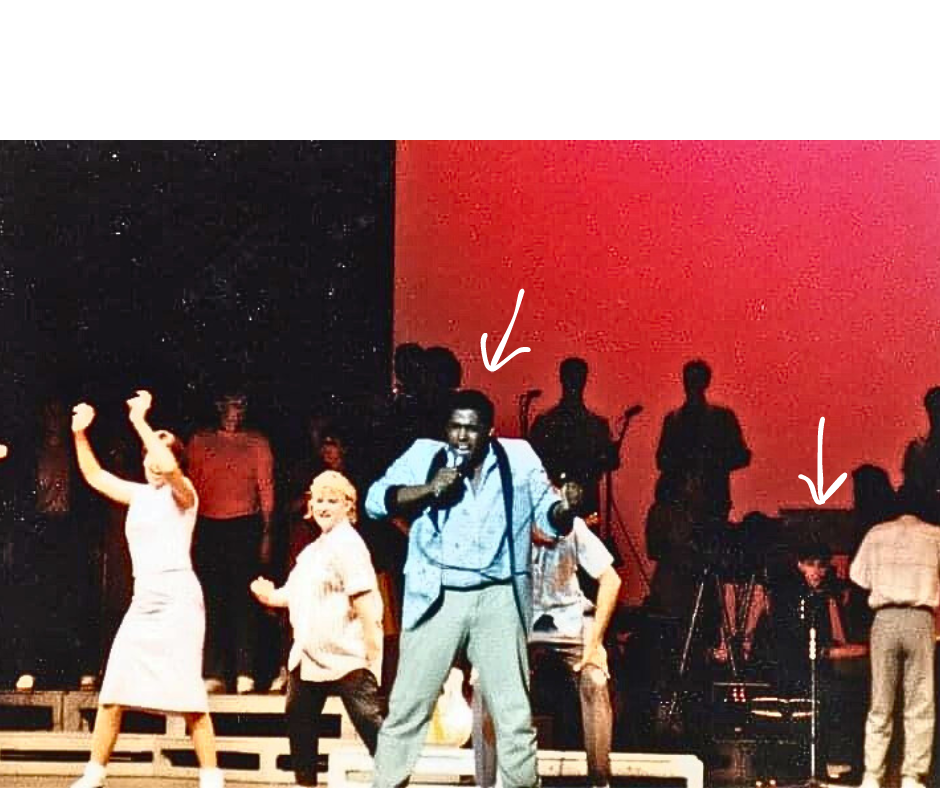
Picture of Up With People performance in 1986 (cast 86C) with arrows pointing to Lionel Cole singing in center and Emily Lewis on drums in back right.
Lionel: Well, I mean, that was like the 80s, right? And, you know, it was a big deal, you know, have a black guy up front, have a girl playing drums. Like, we were the cast that they took a lot of chances on. You know, your mom is super powerful, right? And I, it was cool watching her trust herself and, you know, encouraged everybody in the band to trust ourselves a little bit more. You know, of course I took that to the furthest inch I could take, I trusted myself to make the music in my head, which got me in trouble a lot. You know, that’s okay. It was, it was worth it, you know, ’cause I think, uh, everybody pulls for the underdogs to make it sound amazing.
Erika: Yeah. From the stories I’ve heard, my mom was a bit of a troublemaker there too.
Lionel: Oh yeah. Just a little bit. Oh yeah. She was definitely a rockstar drummer.
Erika: She would like to hear you say that.
So you, you traveled with this, this group of young adults around the world for a year, playing music and staying with host families and volunteering. What was that sense of community like?
Lionel: It feels a lot like now. I mean, my, this whole last tour, I stayed with host families and, you know, did whatever was to be done in the community that they were into, went to places that they went and introduced myself.
I think civic responsibility should be mandatory, you know, whether you do military, Peace Corps, people, you know, join the local library task force. I think having to work in communities, and then having the ability to live in a family in a community that’s not your own just changes your perspective on it gives you such a greater appreciation of small details and how much they can mean.
I just remember having that moment of Western first world problems like, what do you mean you’re giving me all the food you have to eat tonight? You know, “no, come share with me!” and actually sitting back and seeing the look on their face of horror. You know, that I, I wouldn’t take any of the food and the joy inside, like, even though you, you want to share having to honor people’s cultural space, you know, and be blessed by, okay, you know, I want to out-nice this, but actually this is what’s necessary, you know, and that’s a very humbling lesson.
We, as first-worlders, we think we can solve everything. Sometimes we’re just supposed to accept what the universe gives us and be grateful for it. So that’s what really stuck with me, sticks with me now.
Erika: Yeah, and I think living with other people or getting close to people with different backgrounds from you really opens up your ability to take on different perspectives and remember, just because I’m used to living this way doesn’t mean it’s the only way. There’s so many possibilities on how we can create our lives. We get to decide what it’s going to look like. I mean, we co create it with our communities.
Lionel: Yes, we do. You know, well, it’s triune, right? It’s the universe, others, and us. You know, and where we sit in that polarity is always shifting, you know, where we are, the more we do when we’re, Oh, wow, I’m sitting in the negative polarity, make sure it points that way. So we get back towards the positive. It’s pretty exciting when you decide to take a first person view.
Erika: So speaking of community, tell me about how you’re raised. How did your family influence you and teach you about how to live creatively?
Lionel: Well, I mean, I think it was sort of expected of me. You know, our family is, comes from a pretty powerful place, you know. Nat was the first black man on television, the first black man on, you know, commercial radio. I remember being the first black guy in a lot of towns on the road, you know, some 45 years later, right?
Erika: *speaking to the audience* That’s Nat King Cole, Lionel’s uncle. (Correction: Nat King Cole led the first black musicians to have their own sponsored program “King Cole Trio Time” on the radio in 1948 and was the first black man to host a nationally broadcasted variety show “The Nat King Cole Show” in 1956.)
Lionel: So my family experience has taught me to light a flame for a radical garden of creativity. Like I, I just, I want, I want to be that safe space where the soft part of everyone can understand, you know, and the hard part of everyone can stand down for a moment and feel the embrace of all of us, right?
Because if we’re talking about love, like love is my organizing factor, so. Love is meant to multiply, right? It doubles itself every time you share it with someone, right? Because, you know, to share love is like twice love, you know? To share pain is like half the pain, right? So it’s like, if you’re open and you’re sharing, you know, both ways, it just becomes this beautiful…I don’t know…magic carpet ride, you know? You got a little bit of control, but the magic’s doing its thing.
Erika: Yeah, that’s beautiful. Other than music, what other forms of creativity have been a part of your life?
Lionel: Well, there was a time that I was an actor. You know, and I guess every, every decade or so I get another shot at it. So, it’s about, I guess I’m about due for something about now and I love that practice. I love studying it. It’s amazing. I’ve been a martial artist a lot of years. And I think that’s an amazing art. I was a copywriter for a little while in Chicago, a television producer for a little while. Um, you know, I ran bars and clubs and stuff for a little while. I think everything involved in true hospitality, I’ve probably done a little time in, from washing dishes to Radio City Music Hall.
So, I figure it’s only one chance around. So, I just try to learn as much as I can, you know. ‘Cause there’s, there’s creativity in the Zen of washing dishes. ‘Cause if you’re in the Zen, then you’re not thinking of your hands. You’re not thinking of the heat. You just be, the dishes wash themselves and it can, it can be very easy.
Erika: When do you know that it’s time to move on to the next creative venture?
Lionel: Um, probably when the cops come to escort you out the door. You know, I, I think, I think I’m getting a better sense of the difference between people’s heavenly dreams and divine proportions, you know, because I tend to think that someone’s dream is worth standing for, and, but I might dream it harder than them.
So I’m finally learning to let people, to let people, you know, not, not to push people beyond their boundaries unless they’ve actually asked me to. You know, because it’s, it’s inferred if you’re listening to me or playing music with me, I’m going to push you, you know, and as I do anything, I do everything.
So I say I won’t push, but I, I can see the beauty in everybody. So clearly every now and then I just got to give it a little shove, like, “Hey, Hey, here’s a little love, this side, look, look, look.” You know, I got to admit it. I love giving a little extra shot of love.
Erika: Okay. So what I’m hearing you saying is it’s so important to you to share the love and amplify people’s voices that sometimes you might get a little over-enthusiastic?
Lionel: Yeah, well, I think, I, I’ve, I’ve learned that like my excitement for other people’s growth is sometimes greater than theirs. Right? And I don’t think you can go wrong with putting too much love on something, but that what happens is, I think sometimes what goes wrong is our idea that that relationship or that situation is forever. You know, it’s like, because things that are forever, there’s no pressure you’re going to put on it that’s ever going to break. You know, something’s got broken because you lovingly put something on it. Well, it’s probably the season, like you said, time for, to take your creativity and move on, right?
You know, like if they say they’ve had enough, they probably have had enough, you know? And most people say they’ve had enough long before they’re full. They start to think about the next thing as opposed to being in the moment of like, right now this is tasty. Like, you know, and I love being in the moment. So, but yeah, every now, I think every now and then for normal humans, I might be a little bit pushy with the love, but shoot me, you know, I don’t mind.
Erika: Yeah. As a coach and seeing people’s capacity for growth and healing, I can get excited too, but people will only change as much as they’re ready to change.
Lionel: Truth. Truth. Despite the product, you know, but I hope that like, you know, peak experiences really move people and being willing to be collateral damage in someone else’s story because I’m so unattached that I can, or at least try to be unattached enough where I can learn the lessons of loving something that’s not for me, you know, it helps makes it easier.
It makes it easier for me to continue to give the magic that’s learnable, you know, and people who aren’t ready to learn a chance to walk out before, you know, it walks into them, you know, cause my door is wide open. If you put yourself in the lens of my door, you’re going to see yourself, you can’t unsee that. And a lot of people weren’t quite, aren’t quite ready to see that. I think you see that in your work.
Erika: Yes. We’re all mirrors of each other and when someone else triggers us, it’s probably because it has something to do with what’s inside us that maybe we haven’t fully accepted. And with your powerful music, it’s all very, very story oriented and moving, and there’s always a message and sometimes people aren’t ready to hear the truth.
Lionel: Yes, it’s true. Being on the vanguard is not for the faint heart, you know, but I realize, uh, for me, the gift of creation is a gift that I’m bound to give. It’s a plague stuck upon me that I must share. And, and I’m grateful for it, I’m grateful for the lessons I keep getting to learn in humility and acceptance because it sure does, it sure does fill the hole of loneliness.
Erika: Can you expand on that? What fills the hole of loneliness?
Lionel: Well, learning, being open to the universe, teaching you what it has to teach you, especially in times of trouble. There’s like some sort of weird, super secret door to a higher level, a boss level up. If you can just walk through the open door that isn’t, whatever chains that bound you to the cycle that makes you realize you’re back at an open door. You know, how many people are stuck and things that happen to them? Before they turn ten, it takes a long time to realize there’s a door just right there and all you have to do is reach out and get it. So yeah, it’s, It’s, I guess in some ways, to make an elegant riddle is to make small time people discovering their own way to themselves, something to read on the walk, because you’re only going to get there when you get there.
Erika: Speaking of discovering yourself, how well do you feel like you know yourself at this point in your life and career?
Lionel: I know myself well enough to trust. And when I don’t, when I don’t trust, I know myself well enough to shut up, go to sleep or keep stepping in the path that I chose. I think fear and I have become friends. I don’t let fear drive the car anymore, but I don’t ignore what he has to say. He’s just another pal in the car. That’s, that’s a good feeling. Cause I think most of us are driven by fear most of our lives and small fears that really aren’t that big of deal, like status or money. You know what I mean? There, those are small things, you know, just the breath! How ’bout that? That’s, that’s worth feeling awesome about, like, you know, just getting it to a simple space in the brain, that’s all for me and everybody around me. That’s why I sing, you know, it doesn’t matter what the words are. I’m just saying, I love you. I’m just saying it over and over and over again in everything I do, that’s anyway, whatever, it’s not cool to be a nerd of love anymore, but you know, nerds have their revenge.
Erika: Speaking of fear, you’ve, I’m sure had to put yourself out there a lot of times over your career and you’ve been on big stages in the spotlight as sold out shows with Mariah Carey and at The Voice. Do you ever get stage fright?
Lionel: I think stage fright and I made a deal, and I made a decision that the butterflies in my stomach weren’t fear, they were excitement. And since then I feel it. And I feel it as potential energy. It just, it’s almost like, “Oh, cool. We’re going to have that kind of show!” You know? ‘Cause oftentimes it’s like, if I’m open enough, I’m just walking into the energy of the room and then trying to whirl it in a circle, you know what I mean? Like, it doesn’t matter what my set list is most of the time, you know, this, this tour, I’m being very intentional, you know, and have something to say and something that I want to offer, you know? So. The room will have to read more of me than me reading it. Um, it’s a very scary, artistic place to be, but I’m really, really excited.
Erika: What’s the intention of this show?
Lionel: Oh, to not underestimate oneself truly, you know, to, to wag the dog as much as possible, rewrite our history in a way that isn’t advantageous, but that is actually supportive of ourselves. ‘Cause if we’re here talking about it, no matter what you and I have been through, we kicked his butt. We’re here talking about it. Like no matter what we’ve been through, if we can have a conversation, that means we were the winner. But that’s, that’s the reclamation project.
Erika: That’s beautiful.
Lionel: Thank you.
Erika: So some people call you the kilted crooner because of your iconic kilt. What led to that fashion choice?
Lionel: Well, um, I was married to a McCulloch and we were in Scotland. And I had just learned that the Tartan had come to Scotland via Hannibal because I just read Hannibal Crosses the Alps. And I thought, man, it would be really cool if, you know, brown people remembered that the kilt came from here. Not brown people realize their African roots were so deep. And I was playing with Mariah Carey and I was like, all right, I’m going to get a hunting ross and I’m going to wear it on stage, and then tell everybody the truth when I get my chance. And, uh, I did, and Mariah even sings about it. It’s the intro at Glastonbury. She’s like, 🎶 “Mr. Lionel Cole and his cute little kilt.” 🎶 Right? 2001. And, and it’s, I haven’t stopped since.
I just, I love making people take a second and question, you know? Like question their bias, I guess, because instead of confronting them, here’s this affable question, you know, I’m happy to historically, emotionally, or spiritually speak about why I feel good without any pants on. Most guys, they don’t know. This is beautiful. It’s amazing. Freedom is amazing because it frees your mind, actually.
Erika: I think fashion is such an important way to express ourselves and, you know, someone takes one look at you and I think they get a pretty good idea that they, you’re comfortable boldly being yourself and, and that makes a powerful statement and confronts people with, am I choosing to do the same?
Lionel: It’s true. Well, isn’t that our, our, our, I mean, that’s like part of the mandate of being an awake human as opposed to a woke human, awake. You want them to think something. You know, you want every person to think something just because we all spend so much time in our own brain shed thinking about what we did wrong.
You know, if we can just get one little flicker of outside light, if I can be that burst of light through the windshield for a second and I’ve done my gig, you know, if they get the courage then to ask a question, no matter how, you know, snarky, you know, that’s, that’s pretty brave. I welcome all comers, you know, so.
Yeah, I don’t know…I’m here to inspire. I DO know. I’m here to inspire. That’s my whole goal. You know, always has been. My mom used to say, “Lionel, you have this giant brain, you could be anything. Honey, be a doctor, be a lawyer.” And I still say the same thing as I did at eight. It’s like, “Mom, you know, you can only touch so many people as a lawyer, a doctor, but with music, you can touch the whole world.” So, yeah, I’m here to inspire. That’s my choice, you know?
Erika: Yeah. Thank you for giving the gift of your creativity to the world. If you could leave the audience with one message, what would it be for someone who might be more timid in their, their artistic endeavors?
Lionel: I would say you must find your voice and sing it in your key, no matter how monotonous it is, you know, and hopefully you will meet other people who harmonize with you, and to take each of those moments as the beautiful moment in your life, and stack them in your card deck because those moments are forever and they can always heal you or someone and you don’t need a whole lot of them to be a creature that generates healing unto itself. So take care of the present moment, put as much love into it as possible. And don’t worry where it lands.
Erika: Thank you. That’s beautiful. Where, where can the audience find you?
Lionel: There’s lionelandtheswingersclub.com for last year’s records. This, this year will be lionelcolemusic.com and the record Small Town, Vol. 1, and that’s out May 1st. The first gig about that is 54 below on the 14th of May. And then the next month at The Velvet Note in Atlanta, the 20th and 21st. So, you know, just making our way back through the country and hopefully we’ll get to see everybody for a minute or two out there as we’re doing.
Erika: Yeah, thank you so much for joining me today, Lionel.
Lionel: You know, I’m, I’m really pleased you asked me. It, it touches me because we’re a family because we’re family and your mom’s my family. So it means a lot to be the uncle you trusted enough to start.
Erika: I thought maybe you’d be too busy traveling the world, but you’ve been very gracious and I wanted you on here because I’ve heard you talk about the importance and beauty of music and art and, and that’s really the message that I want to spread too. We are all creative beings. It, it hurts me when I hear people say, I’m not creative. It’s just not true. We all have that. We can all cultivate more of it. And when we cultivate it, there’s, there’s more love, there’s more community and more beauty in the world. So thank you for, for being a part of that beauty in the world.
Lionel: I’m just the mirror. I’m glad you can see your reflection.
Erika: Thank you, Lionel, for being here today and sharing your wisdom. And thank you to my listeners for supporting the show as always, please like subscribe and review so more people can benefit from creative life. I want to hear from you. How has creativity affected your life? Email me at embodiedlifecreation@gmail.com and we can share your story on this podcast or blog post. Thank you.







 Embodied Life Creation